Back

College of Respiratory
Therapists of Ontario


RESPONSIBILITIES UNDER
CONSENT LEGISLATION

Professional Practice Guideline


April 2022

PROFESSIONAL PRACTICE GUIDELINE

College of Respiratory Therapists of Ontario (CRTO) publications contain practice parameters and standards that should be considered by all Ontario Respiratory Therapists in the care of their patients/clients and in the practice of the profession. CRTO publications are developed in consultation with professional practice leaders and describe current professional expectations. It is important to note that these CRTO publications may be used by the CRTO or other bodies in determining whether appropriate standards of practice and professional responsibilities have been maintained.


Resources and references are hyperlinked to the Internet for convenience and referenced to encourage exploration of information related to individual areas of practice and/or interests. Bolded terms are defined in the Glossary.


It is important to note that employers may have policies related to an RT’s ability to obtain consent from patients/clients. If an employer’s policies are more restrictive than the CRTO’s expectations, the RT must abide by the employer’s policies. Where an employer’s policies are more permissive than the expectations of the CRTO, the RT must adhere to the expectations of the CRTO.

Obtaining consent to treat a patient is embedded within the CRTO’s standards of practice, in other words, it would be professional misconduct to proceed to treat a patient without consent. The CRTO’s Standards of Practice and A Commitment to Ethical Practice documents provide further guidance to RTs surrounding their obligation and accountability in obtaining consent. This Professional Practice Guideline (PPG) provides an overview of the legislation, specifically the Health Care Consent Act (HCCA) and Substitute Decision Act (SDA) for RTs. The information is structured to first describe how to obtain consent for treatment from a capable person, and then how to proceed with obtaining consent for an incapable person. The key terms in bold are defined in the Glossary.

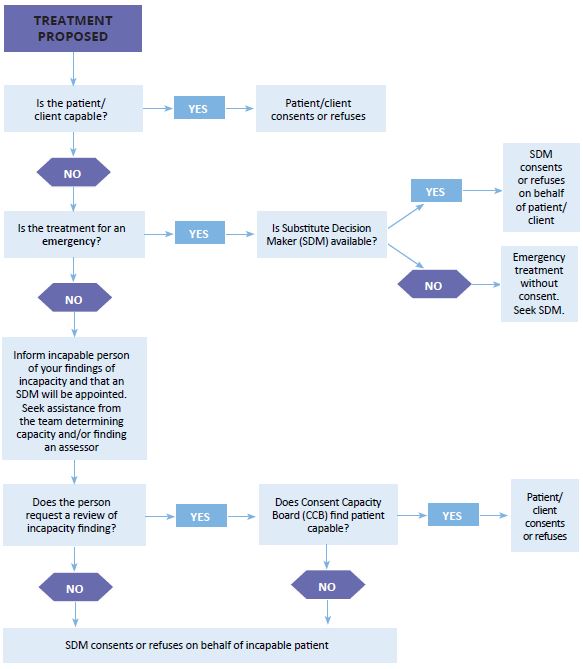
Obtaining consent can be guided by a step-by-step process that RTs should consider every time they are faced with obtaining consent for treatment. A decision tree is included as a visual aid below to assist RTs in their process of obtaining consent and to complement the outline of the PPG. RTs must remember to act within their scope of practice and use their professional judgement to always advocate for the best interests of their patients and assist patients/clients to understand the information relevant to making decisions to the extent permitted by the patients/clients’ capacity.

QUESTIONS OR FEEDBACK?

    This Professional Practice Guideline will be updated as new evidence emerges or as practice evolves. Comments on this guideline are welcome and should be addressed to:
    College of Respiratory Therapists of Ontario, 90 Adelaide Street West, Suite 300, Toronto, Ontario M5H 3V9
    Phone 416-591-7800 | Toll Free 1-800-261-0528 | Fax 416-591-7890 | E-mail questions@crto.on.ca
    INTRODUCTION

    The Health Care Consent Act (HCCA) and the Substitute Decisions Act (SDA) describe the legislative requirements for Respiratory Therapists (RTs) in regards to obtaining consent. The HCCA specifies that regulated health professionals are to follow their CRTO’s guidelines relating to obtaining consent and the provision of information to patients/clients who are found to be incapable.

    The HCCA deals with obtaining consent in the following circumstances:

    9

    (i) for treatment,

    9

    (ii) for admission to a care facility and

    9

    (iii) for receiving personal assistance services.

    In the context of Respiratory Therapy’s scope of practice, RTs are generally accountable for obtaining consent (or ensuring that consent has been obtained) from patients/clients regarding treatment.

    Legislation

    The Health Care Consent Act (HCCA)

    The purposes of the HCCA are:

    9

    (a) to provide rules with respect to consent to treatment that apply consistently in all settings;

    9

    (b) to facilitate treatment, admission to or confining in care facilities, and personal assistance services, for persons lacking the capacity to make decisions about such matters;

    9

    (c) to enhance the autonomy of persons for whom treatment is proposed, persons for whom admission to or confining in a care facility is proposed and persons who are to receive personal assistance services by,

    9

    (i) allowing those who have been found to be incapable to apply to a tribunal for a review of the finding,

    9

    (ii) allowing incapable persons to request that a representative of their choice be appointed by the tribunal for the purpose of making decisions on their behalf concerning treatment, admission to or confining in a care facility or personal assistance services, and

    9

    (iii) requiring that wishes with respect to treatment, admission to or confining in a care facility or personal assistance services, expressed by persons while capable and after attaining 16 years of age, be adhered to;

    9

    (d) to promote communication and understanding between health practitioners and their patients or clients;

    9

    (e) to ensure a significant role for supportive family members when a person lacks the capacity to make a decision about a treatment, an admission to or a confining in a care facility or a personal assistance service; and

    9

    (f) to permit intervention by the Public Guardian and Trustee only as a last resort in decisions on behalf of incapable persons concerning treatment, admission to or confining in a care facility or personal assistance services.

    (HCCA 1996, c.2, Sched. A, s.1)

    The Substitute Decision Act (SDA)

    The SDA deals with decision making about personal care (and/or property) on behalf of incapable persons and involves the appointment of substitute decision makers (SDMs). Please see section on SDMs.

    Glossary

    Attorney for personal care: An attorney under a power of attorney for personal care given under the Substitute Decisions Act.

    Consent and Capacity (the board): A board established by and accountable to the government. Its members are appointed by the government. The Board considers applications for review of findings of incapacity, applications relating to the appointment of a representative, and applications for direction regarding the best interests and wishes of an incapable person.

    Capable: Means mentally capable; a person is capable if they are able to understand the information that is relevant to making a decision about the treatment and are able to appreciate the reasonable foreseeable consequences of a decision or lack of decision — capacity has a corresponding meaning.

    College: College of Respiratory Therapists of Ontario.

    CRTO: College of Respiratory Therapists of Ontario.

    Emergency: When the person for whom the treatment is proposed is apparently experiencing severe suffering or is at risk, if the treatment is not administered promptly, of sustaining serious bodily harm.

    Guardian of the Person: A guardian of the person appointed under the Substitute Decisions Act.

    HPPC: Health Professions Procedural Code — Schedule 2 of the Regulated Health Professions Act.

    Incapable: Mentally incapable with incapacity having a corresponding meaning.

    Partners: Individuals who have lived together for at least one year and have a close personal relationship that is of primary importance in both lives.

    Plan of Treatment: A plan that:

        • is developed by one or more health practitioners
        • deals with one or more health problems that an individual has, and may deal with one or more problems an individual is likely to have in the future given their current health
        • allows for administration of various treatments or courses of treatment.

    Relatives: Related by blood, marriage or adoption.

    Respiratory Care: Equivalent to Respiratory Therapy.

    Respiratory Therapist (RT): A Member of the CRTO and includes Registered Respiratory Therapists (RRT), Practical (limited) Respiratory Therapist (PRT) or Graduate Respiratory Therapists (GRT).

    Spouses: Individuals who are married to each other, or who are living in a conjugal relationship and have lived together for at least one year, have a cohabitation agreement or are the parents (together) of a child. Individuals living apart and separate are not spouses.

    Treatment: Means anything that is done for a therapeutic, preventative, palliative, diagnostic, cosmetic or other health-related purpose, and includes a course of treatment or plan of treatment, but does not include:

        • assessment of a person’s capacity
        • assessment or examination to determine the general nature of an individual’s condition
        • taking a health history
        • communicating an assessment or diagnosis
        • admission to a hospital or other facility
        • a personal assistance service
        • a treatment that, in the circumstances, poses little or no risk of harm
    REFERENCES
    1. College of Nurses of Ontario (2017). Practice Guideline: Consent. Retrieved from: https://www.cno.org/globalassets/docs/policy/41020_consent.pdf (cno.org)
    2. Health Care Consent Act (1996).  Retrieved from: Health Care Consent Act, 1996, S.O. 1996, c. 2, Sched. A (ontario.ca)
    3. Health Protection and Procedure Act (1990). Retrieved from: R.R.O. 1990, Reg. 569: REPORTS (ontario.ca)
    4. Regulated Health Professions Act, 1991, S.O. 1991, c. 18. Retrieved from: Regulated Health Professions Act, 1991, S.O. 1991, c. 18 (ontario.ca)

    Treatment

    Treatment

    The HCCA defines a treatment to mean “anything that is done for a therapeutic, preventive, palliative, diagnostic, cosmetic or other health-related purpose, and includes a course of treatment, plan of treatment or community treatment plan”. In this context, treatment does not include:

    9

    (a) the assessment for the purpose of this Act of a person’s capacity with respect to a treatment, admission to or confining in a care facility or a personal assistance service, the assessment for the purpose of the Substitute Decisions Act, 1992 of a person’s capacity to manage property or a person’s capacity for personal care, or the assessment of a person’s capacity for any other purpose,

    9

    (b) the assessment or examination of a person to determine the general nature of the person’s condition,

    9

    (c) the taking of a person’s health history,

    9

    (d) the communication of an assessment or diagnosis,

    9

    (e) a person’s confining in a care facility;

    9

    (f) a personal assistance service,

    9

    (g) a treatment that in the circumstances poses little or no risk of harm to the person,

    9

    (h) anything prescribed by the regulations as not constituting treatment.

    [HCCA 199 s. 2(1)]

    Plan of Treatment

    The HCCA defines the plan of treatment to mean a plan that

    9

    (a) is developed by one or more health practitioners,

    9

    (b) deals with one or more of the health problems that a person has and may, in addition, deal with one or more of the health problems that the person is likely to have in the future given the person’s current health condition, and

    9

    (c) provides for the administration to the person of various treatments or courses of treatment and may, in addition, provide for the withholding or withdrawal of treatment in light of the person’s current health condition.

    [HCCA 1996, s. 2(1)]

    Therefore, the practitioner proposing a treatment or plan of treatment to a patient/client is responsible for obtaining consent. It is likely that the person proposing the treatment or plan of treatment will be the physician who orders the treatment. However, if an RT is proposing the plan of treatment, it is the RT’s responsibility to obtain consent.

    Third-Party Consent

    The HCCA also allows for a plan of treatment to be proposed by one health care practitioner on behalf of the health care team involved in the plan. This is referred to as “third-party consent” and is acceptable practice provided the consent is informed and obtained prior to initiating the treatment. It is important to remember that if you are the one performing the procedure, you are accountable for ensuring that third-party consent has been obtained. If you have any doubt whether informed consent has been obtained, it is your professional obligation to obtain it, or to not proceed. The definitions of consent and informed consent are discussed in detail in the section about Consent.

    Scenario:

    A patient/client comes to your laboratory for pulmonary function tests and says “My doctor sent me here for some tests.”

    What do you do?

    You must ensure that your patient/client understands the purpose and risks of the tests and verify their consent for the procedure.

    Glossary

    Attorney for personal care: An attorney under a power of attorney for personal care given under the Substitute Decisions Act.

    Consent and Capacity (the board): A board established by and accountable to the government. Its members are appointed by the government. The Board considers applications for review of findings of incapacity, applications relating to the appointment of a representative, and applications for direction regarding the best interests and wishes of an incapable person.

    Capable: Means mentally capable; a person is capable if they are able to understand the information that is relevant to making a decision about the treatment and are able to appreciate the reasonable foreseeable consequences of a decision or lack of decision — capacity has a corresponding meaning.

    College: College of Respiratory Therapists of Ontario.

    CRTO: College of Respiratory Therapists of Ontario.

    Emergency: When the person for whom the treatment is proposed is apparently experiencing severe suffering or is at risk, if the treatment is not administered promptly, of sustaining serious bodily harm.

    Guardian of the Person: A guardian of the person appointed under the Substitute Decisions Act.

    HPPC: Health Professions Procedural Code — Schedule 2 of the Regulated Health Professions Act.

    Incapable: Mentally incapable with incapacity having a corresponding meaning.

    Partners: Individuals who have lived together for at least one year and have a close personal relationship that is of primary importance in both lives.

    Plan of Treatment: A plan that:

        • is developed by one or more health practitioners
        • deals with one or more health problems that an individual has, and may deal with one or more problems an individual is likely to have in the future given their current health
        • allows for administration of various treatments or courses of treatment.

    Relatives: Related by blood, marriage or adoption.

    Respiratory Care: Equivalent to Respiratory Therapy.

    Respiratory Therapist (RT): A Member of the CRTO and includes Registered Respiratory Therapists (RRT), Practical (limited) Respiratory Therapist (PRT) or Graduate Respiratory Therapists (GRT).

    Spouses: Individuals who are married to each other, or who are living in a conjugal relationship and have lived together for at least one year, have a cohabitation agreement or are the parents (together) of a child. Individuals living apart and separate are not spouses.

    Treatment: Means anything that is done for a therapeutic, preventative, palliative, diagnostic, cosmetic or other health-related purpose, and includes a course of treatment or plan of treatment, but does not include:

        • assessment of a person’s capacity
        • assessment or examination to determine the general nature of an individual’s condition
        • taking a health history
        • communicating an assessment or diagnosis
        • admission to a hospital or other facility
        • a personal assistance service
        • a treatment that, in the circumstances, poses little or no risk of harm
    REFERENCES
    1. College of Nurses of Ontario (2017). Practice Guideline: Consent. Retrieved from: https://www.cno.org/globalassets/docs/policy/41020_consent.pdf (cno.org)
    2. Health Care Consent Act (1996).  Retrieved from: Health Care Consent Act, 1996, S.O. 1996, c. 2, Sched. A (ontario.ca)
    3. Health Protection and Procedure Act (1990). Retrieved from: R.R.O. 1990, Reg. 569: REPORTS (ontario.ca)
    4. Regulated Health Professions Act, 1991, S.O. 1991, c. 18. Retrieved from: Regulated Health Professions Act, 1991, S.O. 1991, c. 18 (ontario.ca)

    Capacity

    Capacity

    Once the treatment has been ordered, an RT must decide if consent has been obtained or if they need to obtain consent before proceeding. In some situations, RTs may find themselves needing to determine whether or not a patient/client is in fact capable to consent to a treatment, and what to do if they suspect the patient is incapable.

    There are many underlying – and sometimes ethical – principles involved in obtaining consent and determining a person’s capacity to consent. One of the first principles to remember is the presumption of capacity. The HCCA states:

    9

    “A person is presumed to be capable with respect to treatment, admission to or confining in a care facility and personal assistance services.” and

    9

    “A person is entitled to rely on the presumption of capacity with respect to another person unless he or she has reasonable grounds to believe that the other person is incapable with respect to the treatment”.

    [HCCA 2017, c. 25, Sched. 5, s.56.]

    In other words, patients/clients are presumed capable unless, in your professional judgement, you have reasonable grounds to believe that they are incapable of consenting to the treatment or treatment plan you are proposing. The HCCA clearly states “no treatment without consent”. If you believe your patient/client to be incapable, the next step is to find a substitute decision maker.

    Capacity Depends on the Treatment

    A person may be incapable with respect to some treatments and capable with respect to others. [HCCA 1996, c. 2, Sched. A, s. 15 (1)]

    Capacity Depends on Time

    A person may be incapable with respect to a treatment at one time and capable at another. [HCCA 1996, c. 2, Sched. A, s. 15 (2)]

    Wishes

    The HCCA states that “a person may, while capable, express wishes with respect to treatment, admission to or confining in a care facility or a personal assistance service” [HCCA 2017, Sched. 5, s.57]. Expressed wishes must be followed even if the patient/client subsequently becomes incapable.

    Scenario:

    1. A COPD patient presenting to the Emergency Department with COPD exacerbation may be capable to consent to an ABG and the administration of oxygen, but may not understand the complexities of intubation.

    2. The patient with COPD exacerbation may have been able to consent to an ABG when they arrived in the ED but may lose the capacity to consent as their condition worsens, with evidence of impending respiratory failure.
    3. With the administration of oxygen, the condition of the patient with COPD exacerbation improves. The hypoxemia is corrected and in your professional judgement, their capacity to consent has returned. You are very concerned that this patient may require intubation.

    What do you do?

    In this case, the RT has made a professional judgement that their patient presenting with COPD exacerbation is capable, but does not understand the treatment – intubation. In addition, the patient’s condition is unstable and their capacity to consent is dependent on their condition at any given time. In order to act in the best interest of the patient, the RT is obligated to seek help from the most responsible physician (and/or other members of the health care team) to discuss their clinical recommendations and findings of capacity. It may be necessary to seek consent from a Substitute Decision Maker (SDM) or to appoint an SDM for the patient. There is also a need to discuss the treatment of intubation with the patient or SDM to ensure that the treatment is understood, and informed consent for treatment (or withholding of treatment) has been received. Finally, it may be an opportune time to discuss the patient’s wishes with the patient or SDM surrounding intubation and end of life decision-making.

    Glossary

    Attorney for personal care: An attorney under a power of attorney for personal care given under the Substitute Decisions Act.

    Consent and Capacity (the board): A board established by and accountable to the government. Its members are appointed by the government. The Board considers applications for review of findings of incapacity, applications relating to the appointment of a representative, and applications for direction regarding the best interests and wishes of an incapable person.

    Capable: Means mentally capable; a person is capable if they are able to understand the information that is relevant to making a decision about the treatment and are able to appreciate the reasonable foreseeable consequences of a decision or lack of decision — capacity has a corresponding meaning.

    College: College of Respiratory Therapists of Ontario.

    CRTO: College of Respiratory Therapists of Ontario.

    Emergency: When the person for whom the treatment is proposed is apparently experiencing severe suffering or is at risk, if the treatment is not administered promptly, of sustaining serious bodily harm.

    Guardian of the Person: A guardian of the person appointed under the Substitute Decisions Act.

    HPPC: Health Professions Procedural Code — Schedule 2 of the Regulated Health Professions Act.

    Incapable: Mentally incapable with incapacity having a corresponding meaning.

    Partners: Individuals who have lived together for at least one year and have a close personal relationship that is of primary importance in both lives.

    Plan of Treatment: A plan that:

        • is developed by one or more health practitioners
        • deals with one or more health problems that an individual has, and may deal with one or more problems an individual is likely to have in the future given their current health
        • allows for administration of various treatments or courses of treatment.

    Relatives: Related by blood, marriage or adoption.

    Respiratory Care: Equivalent to Respiratory Therapy.

    Respiratory Therapist (RT): A Member of the CRTO and includes Registered Respiratory Therapists (RRT), Practical (limited) Respiratory Therapist (PRT) or Graduate Respiratory Therapists (GRT).

    Spouses: Individuals who are married to each other, or who are living in a conjugal relationship and have lived together for at least one year, have a cohabitation agreement or are the parents (together) of a child. Individuals living apart and separate are not spouses.

    Treatment: Means anything that is done for a therapeutic, preventative, palliative, diagnostic, cosmetic or other health-related purpose, and includes a course of treatment or plan of treatment, but does not include:

        • assessment of a person’s capacity
        • assessment or examination to determine the general nature of an individual’s condition
        • taking a health history
        • communicating an assessment or diagnosis
        • admission to a hospital or other facility
        • a personal assistance service
        • a treatment that, in the circumstances, poses little or no risk of harm
    REFERENCES
    1. College of Nurses of Ontario (2017). Practice Guideline: Consent. Retrieved from: https://www.cno.org/globalassets/docs/policy/41020_consent.pdf (cno.org)
    2. Health Care Consent Act (1996).  Retrieved from: Health Care Consent Act, 1996, S.O. 1996, c. 2, Sched. A (ontario.ca)
    3. Health Protection and Procedure Act (1990). Retrieved from: R.R.O. 1990, Reg. 569: REPORTS (ontario.ca)
    4. Regulated Health Professions Act, 1991, S.O. 1991, c. 18. Retrieved from: Regulated Health Professions Act, 1991, S.O. 1991, c. 18 (ontario.ca)

    Consent

    Elements of Consent

    Once you have determined that your patient is capable to consent to treatment, you must ensure that the four elements of consent are achieved.

    The following are the elements required for consent to treatment:

    9

    1. Consent must relate to the treatment.

    9

    2. Consent must be informed.

    9

    3. Consent must be voluntary.

    9

    4. Consent must not be obtained through misrepresentation or fraud

    [HCCA 1996, s. 11].

    Informed Consent

    Informed consent is based on the concept that every person has the right to determine what will be done to their body. This is the principle of autonomy. Informed consent means that the information relating to the treatment must be received and understood by the patient/client. This may include communication other than speaking. For example, a patient/client with a hearing impairment may need the information provided in writing or by sign language. When a language barrier exists, an interpreter may be needed. It is your responsibility to meet your patient’s/client’s communication needs to the best of your ability. Using plain language in your explanation of the treatment is one way to facilitate understanding and appreciation of the information relayed.

    Consent is informed if:

    9

    the person received information about the treatment or procedure that a reasonable person in the same circumstances would require in order to make a decision about the treatment, including:

    9

    the nature of the treatment;

    9

    the expected benefits of the treatment;

    9

    the material risks of the treatment;

    9

    the material side effects of the treatment;

    9

    alternative courses of action;

    9

    the likely consequences of not having the treatment, and

    9

    the person received answers to any questions they had about the treatment.

    [HCCA 1996, s. 11]

    Implied and Expressed Consent

    Consent may also be implied or expressed.

    Implied consent is determined by the actions of the patient/client. Implied consent may be inferred when you are performing a procedure with minimal risk that the patient/client has consented to previously and acts in a manner that implies their consent. For example, if you inform your patient/client that you would like to auscultate their chest and they unbutton their shirt, it may be reasonable to infer that they consent. If you have any doubt at all, you must ensure that the patient/client or their representative consents.

    Expressed consent is more official and may be written or oral. For example, having a signed consent form or, having the patient consent to treatment verbally in front of another health care provider are expressed forms of consent. Unless circumstances dictate otherwise, you may presume that consent to a treatment includes consent to a variation in that treatment, provided that the nature, expected outcome, risks and side effects are not significantly different from the original proposed treatment. This presumption is also appropriate where the treatment is being continued in a different location and there remains no significant changes in the expected benefits, risks, or side effects [HCCA, section 12].

    It is important to remember that consent may be withdrawn at any time and depends on the context of the situation (nature of the treatment, time and place) and the patient’s/client’s capacity to consent.

    If you have reasonable grounds to believe your patient/client is incapable of giving informed consent you will have to obtain informed consent from a Substitute Decision Maker (SDM). (Please refer to the section on Substitute Decision Makers.)

    RTs who are unsure whether or not a patient/client is capable to consent should seek assistance, likely from the prescriber of the treatment. Your employer may set out additional policies and procedures to direct your conduct in circumstances where you believe the patient/client is not capable of giving or withholding consent. Where those policies and procedures require you to refer your concerns to a physician or other health care professional then you may defer the finding of incapacity to that health care provider.

    For more information on Capacity Assessments visit the Ministry of The Attorney General’s Capacity Assessment Office.

    For more information on Evaluators and Assessors of Capacity in the Health Care Consent Act.

    Age of Consent

    The HCCA does not identify an age at which an individual may give or withhold consent. This is because the capacity to make independent health care decisions is not dependent on age, but more on the ability to understand the relative risks and benefits of a proposed plan of care. As is outlined in the Child and Family Services Act, “consent is an informed process and the patient needs to be able to understand the foreseeable risk of treatment”. Therefore, a determination of capacity must be made for minor children and young adolescents in the same manner as it would be for an adult.

    Scenario:

    A patient has just been discharged from hospital to home with an order for oxygen. The RT working for the home care company will see the patient in their home to do the set up.  The patient is confused and disoriented and does not understand why the RT is in their home or the reason for the oxygen. The RT attempts to explain the equipment, but the patient is not receptive.  At this time, it is uncertain if the patient provided informed consent for home oxygen while in hospital. The patient lives alone, has a wood fireplace and a gas stove, and it becomes clear that this is not a safe environment.

    The RT shares their concerns with the patient and asks if they have family or friends nearby to help. The patient states they have no family living in the country. The RT contacts the hospital and learns that the home care nurse will not see the patient until tomorrow and you are unsuccessful in reaching the patient’s physician. What is the best course of action for the RT at this point?

    What do you do?

    In this scenario, the RT has taken all of the right steps to consider the welfare of the patient/client above all else (Standard 14: Safety and Risk Management). They have deemed the client incapable of providing informed consent, informed the patient of their findings, has attempted to contact an SDM and has attempted to engage the health care team for assistance in determining capacity and consent.  RTs are not authorized to perform official capacity evaluations or assessments under the HCCA or SDA respectively.  At this time, the best actions for the RT would be to either ensure contact with the ordering/MRP before leaving to arrange an alternate treatment plan or to arrange for the client to return to the hospital from which they had been discharged.   It may be a difficult decision and action to take but the RT is ultimately accountable to acting in the best interest of the patient/client.  For more information on ethical decision making, please see please see A Commitment to Ethical Practice.

    Glossary

    Attorney for personal care: An attorney under a power of attorney for personal care given under the Substitute Decisions Act.

    Consent and Capacity (the board): A board established by and accountable to the government. Its members are appointed by the government. The Board considers applications for review of findings of incapacity, applications relating to the appointment of a representative, and applications for direction regarding the best interests and wishes of an incapable person.

    Capable: Means mentally capable; a person is capable if they are able to understand the information that is relevant to making a decision about the treatment and are able to appreciate the reasonable foreseeable consequences of a decision or lack of decision — capacity has a corresponding meaning.

    College: College of Respiratory Therapists of Ontario.

    CRTO: College of Respiratory Therapists of Ontario.

    Emergency: When the person for whom the treatment is proposed is apparently experiencing severe suffering or is at risk, if the treatment is not administered promptly, of sustaining serious bodily harm.

    Guardian of the Person: A guardian of the person appointed under the Substitute Decisions Act.

    HPPC: Health Professions Procedural Code — Schedule 2 of the Regulated Health Professions Act.

    Incapable: Mentally incapable with incapacity having a corresponding meaning.

    Partners: Individuals who have lived together for at least one year and have a close personal relationship that is of primary importance in both lives.

    Plan of Treatment: A plan that:

        • is developed by one or more health practitioners
        • deals with one or more health problems that an individual has, and may deal with one or more problems an individual is likely to have in the future given their current health
        • allows for administration of various treatments or courses of treatment.

    Relatives: Related by blood, marriage or adoption.

    Respiratory Care: Equivalent to Respiratory Therapy.

    Respiratory Therapist (RT): A Member of the CRTO and includes Registered Respiratory Therapists (RRT), Practical (limited) Respiratory Therapist (PRT) or Graduate Respiratory Therapists (GRT).

    Spouses: Individuals who are married to each other, or who are living in a conjugal relationship and have lived together for at least one year, have a cohabitation agreement or are the parents (together) of a child. Individuals living apart and separate are not spouses.

    Treatment: Means anything that is done for a therapeutic, preventative, palliative, diagnostic, cosmetic or other health-related purpose, and includes a course of treatment or plan of treatment, but does not include:

        • assessment of a person’s capacity
        • assessment or examination to determine the general nature of an individual’s condition
        • taking a health history
        • communicating an assessment or diagnosis
        • admission to a hospital or other facility
        • a personal assistance service
        • a treatment that, in the circumstances, poses little or no risk of harm
    REFERENCES
    1. College of Nurses of Ontario (2017). Practice Guideline: Consent. Retrieved from: https://www.cno.org/globalassets/docs/policy/41020_consent.pdf (cno.org)
    2. Health Care Consent Act (1996).  Retrieved from: Health Care Consent Act, 1996, S.O. 1996, c. 2, Sched. A (ontario.ca)
    3. Health Protection and Procedure Act (1990). Retrieved from: R.R.O. 1990, Reg. 569: REPORTS (ontario.ca)
    4. Regulated Health Professions Act, 1991, S.O. 1991, c. 18. Retrieved from: Regulated Health Professions Act, 1991, S.O. 1991, c. 18 (ontario.ca)

    Decision Tree for Obtaining Consent to Treatment

    Glossary

    Attorney for personal care: An attorney under a power of attorney for personal care given under the Substitute Decisions Act.

    Consent and Capacity (the board): A board established by and accountable to the government. Its members are appointed by the government. The Board considers applications for review of findings of incapacity, applications relating to the appointment of a representative, and applications for direction regarding the best interests and wishes of an incapable person.

    Capable: Means mentally capable; a person is capable if they are able to understand the information that is relevant to making a decision about the treatment and are able to appreciate the reasonable foreseeable consequences of a decision or lack of decision — capacity has a corresponding meaning.

    College: College of Respiratory Therapists of Ontario.

    CRTO: College of Respiratory Therapists of Ontario.

    Emergency: When the person for whom the treatment is proposed is apparently experiencing severe suffering or is at risk, if the treatment is not administered promptly, of sustaining serious bodily harm.

    Guardian of the Person: A guardian of the person appointed under the Substitute Decisions Act.

    HPPC: Health Professions Procedural Code — Schedule 2 of the Regulated Health Professions Act.

    Incapable: Mentally incapable with incapacity having a corresponding meaning.

    Partners: Individuals who have lived together for at least one year and have a close personal relationship that is of primary importance in both lives.

    Plan of Treatment: A plan that:

        • is developed by one or more health practitioners
        • deals with one or more health problems that an individual has, and may deal with one or more problems an individual is likely to have in the future given their current health
        • allows for administration of various treatments or courses of treatment.

    Relatives: Related by blood, marriage or adoption.

    Respiratory Care: Equivalent to Respiratory Therapy.

    Respiratory Therapist (RT): A Member of the CRTO and includes Registered Respiratory Therapists (RRT), Practical (limited) Respiratory Therapist (PRT) or Graduate Respiratory Therapists (GRT).

    Spouses: Individuals who are married to each other, or who are living in a conjugal relationship and have lived together for at least one year, have a cohabitation agreement or are the parents (together) of a child. Individuals living apart and separate are not spouses.

    Treatment: Means anything that is done for a therapeutic, preventative, palliative, diagnostic, cosmetic or other health-related purpose, and includes a course of treatment or plan of treatment, but does not include:

        • assessment of a person’s capacity
        • assessment or examination to determine the general nature of an individual’s condition
        • taking a health history
        • communicating an assessment or diagnosis
        • admission to a hospital or other facility
        • a personal assistance service
        • a treatment that, in the circumstances, poses little or no risk of harm
    REFERENCES
    1. College of Nurses of Ontario (2017). Practice Guideline: Consent. Retrieved from: https://www.cno.org/globalassets/docs/policy/41020_consent.pdf (cno.org)
    2. Health Care Consent Act (1996).  Retrieved from: Health Care Consent Act, 1996, S.O. 1996, c. 2, Sched. A (ontario.ca)
    3. Health Protection and Procedure Act (1990). Retrieved from: R.R.O. 1990, Reg. 569: REPORTS (ontario.ca)
    4. Regulated Health Professions Act, 1991, S.O. 1991, c. 18. Retrieved from: Regulated Health Professions Act, 1991, S.O. 1991, c. 18 (ontario.ca)

    Incapacity

    Incapacity

    If you believe a patient/client is incapable regarding a proposed treatment or treatment plan, you must tell them that you find them to be incapable. If your patient/client regains capacity with respect to a specific treatment or plan of treatment after consent was obtained from a substitute decision-maker, you must then tell them that they were found to be incapable to consent at that time.

    If at any time your patient/client is sufficiently aware and communicative to understand, you must tell them that they had been found incapable. You are not required to tell your patient/client of a finding of incapacity if you believe they would not understand the information due their to age (e.g. newborn) or health condition (e.g. obtunded, or severe dementia).

    When you inform a patient/client that there has been a finding of incapacity, you must:

    9

    1. Inform the patient/client, that you believe they are not capable of making their own decision with respect to the proposed treatment.

    9

    2. Disclose who the substitute decision maker is who will be making treatment decisions on their behalf.

    9

    3. Tell the patient/client that they may appeal the finding of incapacity or the choice of substitute decision-maker to the:

    Consent and Capacity Board
    151 Bloor Street West, 10th Floor
    Toronto, Ontario M5S 2T5
    1-866-777-7391
    www.ccboard.on.ca

    9

    4. Help the patient/client exercise their rights by (as a minimum) referring them to the staff person in the hospital or health facility who provides assistance, or advise the patient/client to contact a lawyer; and

    9

    5. Provide this information in a very helpful and sensitive manner that is approachable, neutral and non-judgemental.

    The situation and circumstance must be properly communicated to the patient/client. Using an interpreter or communication aid may be necessary, depending on the individual patient/client needs.

    Glossary

    Attorney for personal care: An attorney under a power of attorney for personal care given under the Substitute Decisions Act.

    Consent and Capacity (the board): A board established by and accountable to the government. Its members are appointed by the government. The Board considers applications for review of findings of incapacity, applications relating to the appointment of a representative, and applications for direction regarding the best interests and wishes of an incapable person.

    Capable: Means mentally capable; a person is capable if they are able to understand the information that is relevant to making a decision about the treatment and are able to appreciate the reasonable foreseeable consequences of a decision or lack of decision — capacity has a corresponding meaning.

    College: College of Respiratory Therapists of Ontario.

    CRTO: College of Respiratory Therapists of Ontario.

    Emergency: When the person for whom the treatment is proposed is apparently experiencing severe suffering or is at risk, if the treatment is not administered promptly, of sustaining serious bodily harm.

    Guardian of the Person: A guardian of the person appointed under the Substitute Decisions Act.

    HPPC: Health Professions Procedural Code — Schedule 2 of the Regulated Health Professions Act.

    Incapable: Mentally incapable with incapacity having a corresponding meaning.

    Partners: Individuals who have lived together for at least one year and have a close personal relationship that is of primary importance in both lives.

    Plan of Treatment: A plan that:

        • is developed by one or more health practitioners
        • deals with one or more health problems that an individual has, and may deal with one or more problems an individual is likely to have in the future given their current health
        • allows for administration of various treatments or courses of treatment.

    Relatives: Related by blood, marriage or adoption.

    Respiratory Care: Equivalent to Respiratory Therapy.

    Respiratory Therapist (RT): A Member of the CRTO and includes Registered Respiratory Therapists (RRT), Practical (limited) Respiratory Therapist (PRT) or Graduate Respiratory Therapists (GRT).

    Spouses: Individuals who are married to each other, or who are living in a conjugal relationship and have lived together for at least one year, have a cohabitation agreement or are the parents (together) of a child. Individuals living apart and separate are not spouses.

    Treatment: Means anything that is done for a therapeutic, preventative, palliative, diagnostic, cosmetic or other health-related purpose, and includes a course of treatment or plan of treatment, but does not include:

        • assessment of a person’s capacity
        • assessment or examination to determine the general nature of an individual’s condition
        • taking a health history
        • communicating an assessment or diagnosis
        • admission to a hospital or other facility
        • a personal assistance service
        • a treatment that, in the circumstances, poses little or no risk of harm
    REFERENCES
    1. College of Nurses of Ontario (2017). Practice Guideline: Consent. Retrieved from: https://www.cno.org/globalassets/docs/policy/41020_consent.pdf (cno.org)
    2. Health Care Consent Act (1996).  Retrieved from: Health Care Consent Act, 1996, S.O. 1996, c. 2, Sched. A (ontario.ca)
    3. Health Protection and Procedure Act (1990). Retrieved from: R.R.O. 1990, Reg. 569: REPORTS (ontario.ca)
    4. Regulated Health Professions Act, 1991, S.O. 1991, c. 18. Retrieved from: Regulated Health Professions Act, 1991, S.O. 1991, c. 18 (ontario.ca)

    When can you treat a patient without consent?

    When can you treat a patient without consent?

    9

    1. A treatment may be administered to an incapable patient/client without obtaining consent only if:

    9

    i. there is an emergency; AND

    9

    ii. the delay to obtain consent will prolong the suffering that the patient/client is apparently experiencing or will put the patient/client at risk of serious bodily harm

    [HCCA, section 25].

    9

    2. A treatment may be administered to an apparently capable patient/client without obtaining consent only if:

    9

    i. there is an emergency; AND

    9

    ii. the communication required to obtain informed consent is not possible due to a language barrier or communication disability; AND

    9

    iii. reasonable steps have been taken to enable communication; AND

    9

    iv. the delay to further means of enabling the communication will prolong the suffering that the patient/client is apparently experiencing or will put the patient/client at risk of serious bodily harm; AND

    9

    v. there is no reason to believe the person does not want the treatment

    [HCCA, section 25].

    9

    3. An examination or diagnostic procedure may be performed without obtaining consent provided that:

    9

    i. the examination or diagnostic procedure is necessary to determine whether or not there is an emergency; AND

    9

    ii. the health care provider believes the patient/client is incapable or that there is a communication barrier that reasonable efforts have not been able to alleviate

    [HCCA, section 25].

    In any case where treatment is given without obtaining consent, you must:

    9

    i. document your opinions with respect to capacity and all actions taken (see Documentation PPG); AND

    9

    ii. continue the treatment only as long as it is reasonably necessary to find a substitute decision maker or to find a practical means to enable communication; AND

    9

    iii. ensure that reasonable efforts are made to find a substitute decision maker or a means of enabling communication

    [HCCA, section 25].

    Glossary

    Attorney for personal care: An attorney under a power of attorney for personal care given under the Substitute Decisions Act.

    Consent and Capacity (the board): A board established by and accountable to the government. Its members are appointed by the government. The Board considers applications for review of findings of incapacity, applications relating to the appointment of a representative, and applications for direction regarding the best interests and wishes of an incapable person.

    Capable: Means mentally capable; a person is capable if they are able to understand the information that is relevant to making a decision about the treatment and are able to appreciate the reasonable foreseeable consequences of a decision or lack of decision — capacity has a corresponding meaning.

    College: College of Respiratory Therapists of Ontario.

    CRTO: College of Respiratory Therapists of Ontario.

    Emergency: When the person for whom the treatment is proposed is apparently experiencing severe suffering or is at risk, if the treatment is not administered promptly, of sustaining serious bodily harm.

    Guardian of the Person: A guardian of the person appointed under the Substitute Decisions Act.

    HPPC: Health Professions Procedural Code — Schedule 2 of the Regulated Health Professions Act.

    Incapable: Mentally incapable with incapacity having a corresponding meaning.

    Partners: Individuals who have lived together for at least one year and have a close personal relationship that is of primary importance in both lives.

    Plan of Treatment: A plan that:

        • is developed by one or more health practitioners
        • deals with one or more health problems that an individual has, and may deal with one or more problems an individual is likely to have in the future given their current health
        • allows for administration of various treatments or courses of treatment.

    Relatives: Related by blood, marriage or adoption.

    Respiratory Care: Equivalent to Respiratory Therapy.

    Respiratory Therapist (RT): A Member of the CRTO and includes Registered Respiratory Therapists (RRT), Practical (limited) Respiratory Therapist (PRT) or Graduate Respiratory Therapists (GRT).

    Spouses: Individuals who are married to each other, or who are living in a conjugal relationship and have lived together for at least one year, have a cohabitation agreement or are the parents (together) of a child. Individuals living apart and separate are not spouses.

    Treatment: Means anything that is done for a therapeutic, preventative, palliative, diagnostic, cosmetic or other health-related purpose, and includes a course of treatment or plan of treatment, but does not include:

        • assessment of a person’s capacity
        • assessment or examination to determine the general nature of an individual’s condition
        • taking a health history
        • communicating an assessment or diagnosis
        • admission to a hospital or other facility
        • a personal assistance service
        • a treatment that, in the circumstances, poses little or no risk of harm
    REFERENCES
    1. College of Nurses of Ontario (2017). Practice Guideline: Consent. Retrieved from: https://www.cno.org/globalassets/docs/policy/41020_consent.pdf (cno.org)
    2. Health Care Consent Act (1996).  Retrieved from: Health Care Consent Act, 1996, S.O. 1996, c. 2, Sched. A (ontario.ca)
    3. Health Protection and Procedure Act (1990). Retrieved from: R.R.O. 1990, Reg. 569: REPORTS (ontario.ca)
    4. Regulated Health Professions Act, 1991, S.O. 1991, c. 18. Retrieved from: Regulated Health Professions Act, 1991, S.O. 1991, c. 18 (ontario.ca)

    Special Considerations

    Special Considerations

    In the unfortunate circumstance that this conversation does not occur between the patient and attending physician and you’re confident the patient made an informed decision regarding CPR, under your professional obligation, CRTO policy and the CRTO’s understanding of the Health Care Consent Act’s intent you have an obligation to not initiate this intervention (CPR) and express the patient’s wishes to the health care team. Conversely, if you are not confident that the patient made an informed decision, then you would participate in CPR.

    Scenario:

    What should I do if a capable patient/client indicates to me that they would not want any heroic measures to save their life – such as cardiopulmonary resuscitation (CPR) – but before the attending physician can write a “Do not resuscitate” order the patient suffers a cardiac/respiratory arrest?

    What do you do?

    In order to follow-through on patient’s/client’s wishes regarding CPR, it is imperative that the attending physician has a discussion with the patient/client as soon as possible. In the meantime, the CRTO recommends that you take the following actions:

    1. At the time that a patient/client makes a statement indicating they do not want life saving measures, explain the nature of the treatment intervention (CPR), expected benefits, risks and the consequences of not receiving CPR if it is required to the patient. You may also want to briefly explain what’s meant by CPR: e.g. intubation, ventilation, compressions, and defibrillation/cardioversion to establish that the patient/client has made an informed decision about what treatment they are declining.
    2. Notify the attending physician immediately and describe what the patient/client has stated.
    3. Ask another health care professional, preferably the patient’s/client’s nurse to witness what the patient has just articulated.
    4. Document a description of the conversation you had with the patient/client in their chart.
    5. Follow-up with the attending physician and confirm the resuscitation status of the patient/client.

    It is important to recognize and acknowledge that patients/clients may not fully comprehend or appreciate the consequences of not having this life saving intervention. (N.B., understanding and appreciating information are different concepts. Understanding is cognitive. Appreciating information means that patient/client grasps the practical implications of their decision. Informed consent requires both comprehending and appreciating the consequences of the decision.) To that end, it is very important that the patient’s attending physician has the opportunity to discuss the likelihood of requiring CPR, the nature of the treatment, expected benefits, risks, alternative treatment options and the consequences of not receiving CPR if required.

    Substitute Decision Maker (SDM)

    A Substitute Decision Maker (SDM) is an individual who may give or withhold consent on behalf of an incapacitated patient/client. The following list of SDMs is in order of priority rank:

    9

    1. Guardian of the person, if they have authority to give or refuse consent to the treatment

    9

    2. Attorney for personal care, if they have the authority to give or refuse consent to the treatment

    9

    3. Representative appointed by the Consent and Capacity Board, if the representative has the authority to give or refuse consent to the treatment

    9

    4. Spouse or partner

    9

    5. Child or parent of the incapable person or children’s aid society or other guardian in place of a parent — this does not include a parent who only has right of access

    9

    6. A parent with right of access only

    9

    7. A brother or sister

    9

    8. Any other relative

    9

    9. The Public Guardian and Trustee [HCCA, section 20]

    The substitute decision-maker must be:

    9

    capable;

    9

    at least 16 years old, unless they are the parent of the incapable person;

    9

    not prohibited by court order or separation agreement from having access or giving or refusing consent;

    9

    available; and

    9

    willing to assume responsibility

    [HCCA, section 20].

    The SDM must also:

    9

    believe that no other person from a higher priority of substitute decision — maker exists, or if they exist they would not object to them making the decision — if there is an individual who is from priority rank 1, 2, or 3 then this decision-maker must be the person making decisions;

    9

    give or refuse consent in accordance with any known wishes expressed by the incapable person when capable and at least 16 years old; and

    9

    act in the best interests of the incapable person if no wishes are known or it is impossible to comply with them

    [HCCA, section 21].

    Where there are two individuals of the same priority of substitute decision-maker who disagree about whether to give or refuse consent for a treatment (and if their rank is ahead of any other potential substitute decision-maker), the Public Guardian and Trustee must then make the decision.

    Consent Capacity Board (CCB)

    A person who is found to be incapable may apply for a review of the finding to the Consent and Capacity Board [HCCA, s. 32]. The only exception to this right is if the person has a guardian with the authority to give or refuse consent to treatment, or the person has an attorney for personal care and the power of attorney waives the person’s right to apply for a review [HCCA, s. 32].

    Except in an emergency, you must not begin a treatment or procedure, and you must take reasonable steps to ensure that the treatment or procedure is not started, following a finding of incapacity until:

    9

    48 hours after you were first informed of an intended application to the Consent and Capacity Board, without an application to the Board being made;

    9

    the application to the Board has been withdrawn;

    9

    the Board has rendered its decision and none of the parties [HCCA, s. 32 and 33] have indicated their intention to appeal;

    9

    the time for initiating an appeal from a Board decision has expired without an appeal being launched after a party to the application has informed you that they intend to appeal; or

    9

    the appeal of the Board decision has been finally disposed of. [HCCA, s. 18].

    What are the Penalties for Failure to Comply with the Consent Legislation?

    The HCCA provides protection from liability for health care practitioners who act in their belief, on reasonable grounds and in good faith, that there was consent for the actions they took [HCCA, section 29]. While it may be reasonable to presume that consent has been given unless you have overt signs that it wasn’t, the CRTO recommends that you verify consent for any
    controlled act you perform, as a minimum.

    It is professional misconduct to do “anything to a patient or client for a therapeutic, preventative, palliative, diagnostic, cosmetic or health-related purpose in a situation in which a consent is required by law, without such a consent” [O. Reg 753/93 – Professional Misconduct, paragraph 3].

    A Member found guilty of professional misconduct may be subject to any one or more of the following [HPPC, s. 51(2)]:

    9

    1. Revocation of the registrant’s certificate of registration;

    9

    2. Suspension of the registrant’s certificate of registration for a specified period of time;

    9

    3. Imposition of terms, limitation or conditions on the registrant’s certificate of registration for a specified or indefinite period of time;

    9

    4. Appearance before the panel for a reprimand;

    9

    5. A fine of up to $35,000, payable to the Minister of Finance.

    Glossary

    Attorney for personal care: An attorney under a power of attorney for personal care given under the Substitute Decisions Act.

    Consent and Capacity (the board): A board established by and accountable to the government. Its members are appointed by the government. The Board considers applications for review of findings of incapacity, applications relating to the appointment of a representative, and applications for direction regarding the best interests and wishes of an incapable person.

    Capable: Means mentally capable; a person is capable if they are able to understand the information that is relevant to making a decision about the treatment and are able to appreciate the reasonable foreseeable consequences of a decision or lack of decision — capacity has a corresponding meaning.

    College: College of Respiratory Therapists of Ontario.

    CRTO: College of Respiratory Therapists of Ontario.

    Emergency: When the person for whom the treatment is proposed is apparently experiencing severe suffering or is at risk, if the treatment is not administered promptly, of sustaining serious bodily harm.

    Guardian of the Person: A guardian of the person appointed under the Substitute Decisions Act.

    HPPC: Health Professions Procedural Code — Schedule 2 of the Regulated Health Professions Act.

    Incapable: Mentally incapable with incapacity having a corresponding meaning.

    Partners: Individuals who have lived together for at least one year and have a close personal relationship that is of primary importance in both lives.

    Plan of Treatment: A plan that:

        • is developed by one or more health practitioners
        • deals with one or more health problems that an individual has, and may deal with one or more problems an individual is likely to have in the future given their current health
        • allows for administration of various treatments or courses of treatment.

    Relatives: Related by blood, marriage or adoption.

    Respiratory Care: Equivalent to Respiratory Therapy.

    Respiratory Therapist (RT): A Member of the CRTO and includes Registered Respiratory Therapists (RRT), Practical (limited) Respiratory Therapist (PRT) or Graduate Respiratory Therapists (GRT).

    Spouses: Individuals who are married to each other, or who are living in a conjugal relationship and have lived together for at least one year, have a cohabitation agreement or are the parents (together) of a child. Individuals living apart and separate are not spouses.

    Treatment: Means anything that is done for a therapeutic, preventative, palliative, diagnostic, cosmetic or other health-related purpose, and includes a course of treatment or plan of treatment, but does not include:

        • assessment of a person’s capacity
        • assessment or examination to determine the general nature of an individual’s condition
        • taking a health history
        • communicating an assessment or diagnosis
        • admission to a hospital or other facility
        • a personal assistance service
        • a treatment that, in the circumstances, poses little or no risk of harm
    REFERENCES
    1. College of Nurses of Ontario (2017). Practice Guideline: Consent. Retrieved from: https://www.cno.org/globalassets/docs/policy/41020_consent.pdf (cno.org)
    2. Health Care Consent Act (1996).  Retrieved from: Health Care Consent Act, 1996, S.O. 1996, c. 2, Sched. A (ontario.ca)
    3. Health Protection and Procedure Act (1990). Retrieved from: R.R.O. 1990, Reg. 569: REPORTS (ontario.ca)
    4. Regulated Health Professions Act, 1991, S.O. 1991, c. 18. Retrieved from: Regulated Health Professions Act, 1991, S.O. 1991, c. 18 (ontario.ca)